
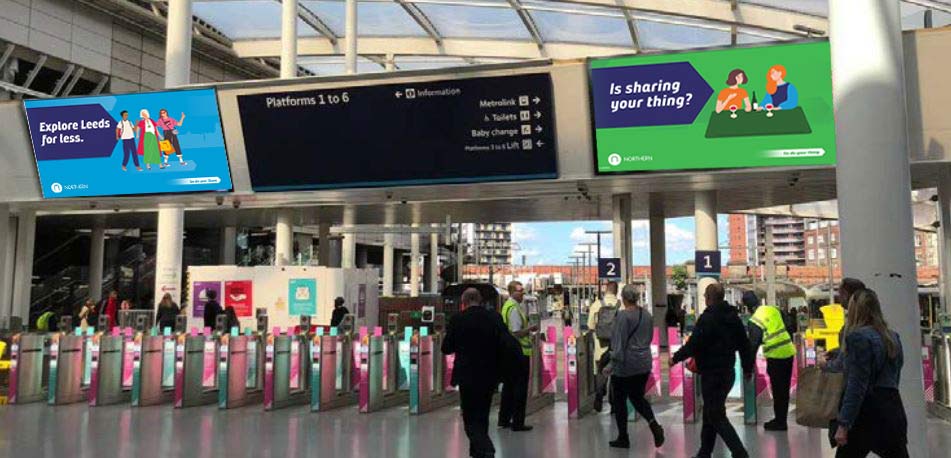
Rail advertising guides tend to be written by people who have never bought any. They tell you the network carries well over a billion journeys a year, that commuters are an attractive audience, and that stations offer high-impact opportunities.
All true. None of it useful. Then comes the contact form, because the actual prices are apparently a secret.
I have planned and bought rail advertising campaigns across the UK network for brands at very different budget levels - from single-station regional campaigns to multi-station London terminus activity. I know what the formats actually look like on a concourse at rush hour, where the pricing genuinely lands, and which placements deliver and which quietly waste money.
Every price below is from the Loud! OOH rate card, with no mark-up.
This guide covers the UK national rail market specifically - railway stations and trains across National Rail. London Underground is a separate market with its own formats, pricing, and dynamics, and we have covered it in its own dedicated guide. This one is about everything from the London termini to your local regional station.
No forms. No vague ranges. No call-us-to-find-out. Just the information you need to make the decision yourself.
First, the numbers that actually matter
The UK national rail network handled approximately 1.7 billion passenger journeys in the year to March 2025 (ORR). Traffic is heavily concentrated: the London termini alone account for hundreds of millions of annual entries and exits, with Liverpool Street the busiest station in Britain at over 80 million.
1.7bn
UK rail journeys a year
ORR · Mar 2025
80.4m
Busiest station · Liverpool Street
Entries and exits
55–70%
Prompted ad recall
Regular station users
1,000+
Stations with ad inventory
Media owner network
~60%
Journeys via London stations
ORR regional data
Two characteristics make rail stations genuinely distinctive as an advertising environment.
~12 min
Dwell time
The average passenger spends around 12 minutes in the station per journey - longer when trains are delayed. People waiting for platform announcements stand still, facing departure boards, in the sightline where the best inventory sits.
~450×
Frequency
A season ticket holder passes through the same station ten times a week, roughly 450 times a year. A well-placed campaign reaches them every working day for the entire period - not once.
Rail commuters skew ABC1, with strong concentrations of professionals and above-average household incomes - particularly on routes into London and major regional cities.
Very few advertising formats build frequency with a defined audience as efficiently as station advertising does.
Who actually uses UK rail stations? The audience question.
The rail audience divides into three broad groups, and the mix varies significantly by station, day of week, and time of day. Understanding which group dominates at your chosen station is fundamental to whether a campaign works.
7–9:30am
Commuters
Same stations, same times, every weekday. ABC1 professionals concentrated on routes into London and major business centres.
20–30 min
Business travellers
Longer dwell than commuters - a Euston–Manchester traveller typically spends 20 to 30 minutes in the station before departure.
Sat–Sun
Leisure travellers
Weekends and holidays shift stations towards families, day-trippers, event-goers, and tourists. Slower movement, longer engagement with retail and food.
Commuter mindset
Morning commuters are alert, routine-driven, and planning their day. Evening commuters are decompressing and more receptive to leisure, entertainment, and consumer messaging. The same panel works differently at different ends of the day - one reason digital formats with daypart scheduling have become so effective.
A station is not one audience. Plan against the segment that matters - not the headline footfall number.
Every format explained
Eight formats across stations and trains - what each one is, what it costs, and who it works for. Full rate card detail in the 2026 rate card.
6-Sheet Posters
The workhorse format. Backlit panels on platforms, in ticket halls and at entrances - passengers waiting for a train are directly in front of them with nothing else demanding attention. Present at 1,000+ UK stations.
Digital
Digital 6-Sheets (D6)
The digital equivalent on station screen networks. Ads rotate on a timed loop with daypart targeting, no print cost, and creative changeable remotely mid-campaign. The fastest-growing segment of rail inventory.
48 & 96-Sheet Billboards
Large format on station approaches, alongside tracks at platform ends, and on exterior walls. Trackside 48-sheets are seen from arriving and departing trains too, adding an on-train audience. Often surprisingly good value regionally.
Digital
Large Format Digital
The premium station format. Full-motion screens above concourses, facing departure boards. When 500 people are staring at the boards, the screen beside them has their attention by default - among the most valuable OOH sites in the country.
Experiential
Concourse & Experiential
Floor-standing sites on main concourses for product displays, sampling and pop-ups. The larger termini have designated experiential zones with power and footfall in the tens of thousands daily. Puts your brand in the path of the audience.
Domination
Station Takeovers
Complete brand presence across a station: every panel, every screen, often wraps on barriers, floors and architecture. Takeovers at the major London termini generate press and social coverage in their own right.
Traincards (Interior)
Printed panels inside carriages, above windows and seats. Commuters sit facing them for a 30–45 minute journey, so traincards support longer copy and direct-response mechanics like QR codes. Sold in fleet packages.
Domination
Train Exterior Wraps
Full or partial branding on the outside of trains - the train becomes a moving campaign across its whole route, seen at every station it calls at and every platform it passes. High production cost, priced on application.
The 2026 rate card
Media cost only, excluding VAT and production. Two-week periods - published openly, no mark-up.
Sort, filter, and compare every format in the table below - the full reference for planning. For all UK OOH formats, see the complete 2026 pricing page.
| Format | Regional | Major regional | London termini | Notes |
|---|---|---|---|---|
| 4/6-sheet station posters | £250–£750 / panel | from £500 / panel | £750–£1,500 / panel | Widest availability, 1,000+ stations |
| Digital 6-sheet (D6) | £450–£1,200 / wk | from £800 / wk | £1,200–£2,200 / wk | Daypart targeting available |
| 48-sheet station large format | £750–£2,000 / panel | from £1,500 / panel | £2,000–£4,500 / panel | Includes trackside sites |
| Traincards (interior) | £75–£150 / panel | from £100 / panel | from £150 / panel | Sold in fleet packages |
| Station domination / takeover | from £2,500 | from £8,000 | from £15,000 | Major termini · longer lead times |
| Large format digital | POA | POA | POA | Premium concourse positions |
| Concourse experiential | POA | POA | POA | Staffing & build additional |
| Train exterior wrap | POA | POA | POA | Production significant, 12+ weeks |
What a real campaign looks like at different budget levels
Individual panel prices only tell you so much. Here is what rail advertising actually looks like across different total budgets - from a local station presence to full domination.
Under £5,000
Entry
Single-station local presence
A handful of 6-sheet panels at a regional or local station, or a short D6 rotation at a major regional station. Genuinely useful for local businesses: your customers see you every day at the station they commute through, for two to four weeks. Local stations remain one of the most underpriced formats in UK outdoor.
£5k – £20k
Growth
Meaningful station presence
Multiple formats at a major regional station, a strong panel package at a London terminus, or traincards across part of a commuter fleet. A £12,000–£15,000 mix of concourse D6s and platform 6-sheets at Leeds or Manchester Piccadilly builds serious frequency with that city's commuters over a month.
£20k – £60k
Scale
Multi-station or premium terminus
Coordinated campaigns across a commuter corridor, premium large-format digital at a London terminus, or traincards across a full fleet. At this level you can own the journey - home station, in-carriage dwell, and terminus panel - frequency almost no other OOH environment can replicate.
£60k+
Domination
Headline channel territory
Station takeovers at major termini, multi-city campaigns, or train livery partnerships. Rail becomes a headline channel - takeovers at the London termini reliably earn press and social coverage on top of the paid audience.
The factors that move the price
Five variables explain most of the difference between two otherwise similar campaigns.
Biggest lever
Station footfall tier
The dominant variable. A 6-sheet at Liverpool Street costs roughly four times the same panel at a mid-sized regional station, reflecting the difference in daily audience. But cost per thousand impressions often favours the regional stations, because their pricing falls faster than their footfall does. If your audience is regional, regional stations are consistently the better value buy.
Placement
Position within the station
Concourse positions facing departure boards command the highest premiums because they sit in the default sightline of waiting passengers. Platform panels deliver long dwell with a captive audience at lower cost. Entrance and walkway sites deliver volume but shorter exposure. The same format can perform very differently depending on where in the passenger flow it sits.
Timing
Seasonality & demand
September to November and January to March are peak, driven by recruitment, financial services, and New Year consumer campaigns. Summer softens commuter volumes but lifts leisure traffic. Flexible timing improves what your budget buys.
Frequency
Campaign duration
Two weeks is the standard trading period. Longer bookings of four weeks and beyond reduce the per-period cost, and because rail's core strength is frequency against a repeating commuter audience, longer campaigns disproportionately outperform short ones in this environment. If the budget allows four weeks instead of two, take the four.
Total cost
Production
Digital carries no production cost. Printed 6-sheets and 48-sheets add print and posting; traincard printing is low per panel but adds up across a fleet. Build production into the total budget from the start.
Does it work? The honest answer on effectiveness.
Rail's defining strength is repetition - the same commuter, the same panel, every working day.
Yes - if you need frequency against commuters
A four-week campaign can deliver ~40 exposures to the same ABC1 audience, with ~12 minutes of dwell each time.
Typical exposures per commuter
Regular season-ticket holder · same station panel · illustrative
Where it's strongest
Recruitment performs exceptionally - you are addressing people during their commute to a job they may want to leave. Financial services, professional services, and B2B brands benefit from the ABC1 commuter concentration. Consumer brands targeting a specific city do well because the audience is geographically defined by the station's catchment. Traincards, with 30 to 45 minutes of in-carriage dwell, genuinely support direct response in a way most outdoor cannot.
What it doesn't do well
Rail reaches rail users, and rail users are not everyone. If your audience drives, works from home, or lives outside commuter catchments, station advertising will miss them. The format is also weaker for broad national reach at low cost. Post-pandemic, Tuesday to Thursday volumes have recovered strongly, but Mondays and Fridays remain quieter - weight digital spend to midweek for efficiency.
Rail advertising is the most efficient frequency-building format in UK outdoor for reaching commuters and city-centre audiences.
Choosing the right stations: a practical framework
Match the station to your audience - not just the biggest footfall number.
London commuters
Liverpool Street skews financial and professional. Paddington carries Thames Valley tech and business. Waterloo and Victoria carry south London and Surrey volumes. Match the terminus to your audience - not just footfall.
City or region
Leeds, Manchester Piccadilly, Birmingham New Street, Glasgow Central, and Edinburgh Waverley each dominate their city's commuter flows - one of the most efficient city-level buys in UK outdoor.
Commuter corridor
Combine origin stations with traincards on that line's fleet for journey-level coverage - home station, in-carriage dwell, and terminus panel in one campaign.
Local business
Own your local station for a few hundred pounds per panel per fortnight. Everyone in the catchment who commutes passes through twice a day - frequently the best value site available.
Ten busiest managed stations
Annual entries and exits · millions · ORR 2024-25
Liverpool Street
City / financial professionals, Essex commuters
Best for Financial and professional services, B2B
Paddington
Thames Valley business, Heathrow
Best for Tech, business services, premium consumer
London Bridge
City workers, south-east commuters
Best for Professional services, consumer brands
Waterloo
SW London & Surrey commuters
Best for Broad ABC1 consumer, financial services
Victoria
South London commuters, Gatwick traffic
Best for Consumer brands, travel, retail
King's Cross / St Pancras
Intercity business, international travellers
Best for Premium brands, B2B, travel
Birmingham New Street
Midlands commuters & intercity
Best for Midlands regional campaigns
Leeds
Yorkshire commuters & business
Best for Yorkshire regional reach, professional services
Glasgow Central
Scottish commuters & intercity
Best for Scottish market campaigns
Manchester Piccadilly
Northern business & commuters
Best for North of England reach, B2B & consumer
The booking process: what actually happens
Allow 3–5 weeks from brief to live for standard poster and D6 campaigns. Printed formats need artwork sign-off followed by print and posting, typically one to two weeks. Digital formats can move faster once approved. Station dominations and train wraps need 8–12 weeks minimum. Premium concourse screens at the London termini are in high demand and book ahead, particularly for autumn and new year periods.
Station selection, format mix, and rate confirmation.
Creative sign-off and CAP compliance check.
Print/posting for posters; digital can move faster once approved.
UK rail advertising inventory is managed by a small number of media owners holding long-term concessions with Network Rail and train operating companies. A multi-station campaign often involves multiple owners - booking through an agency consolidates that into one plan and gives you leverage on rates that direct bookings do not.
Is rail advertising right for an SME?
When it makes sense
- Your customers are concentrated in a specific town, city, or commuter catchment
- You want repeated exposure to the same audience rather than one-off reach
- You are recruiting, and want to reach employed professionals during their commute
- Your local station carries meaningful footfall and panel prices start in the hundreds, not thousands
- You can run the campaign for four weeks or more to let the frequency effect build
When to think twice
- Your audience predominantly drives or works from home
- You need broad national reach on a limited budget
- You need immediate, trackable response as the primary metric
- Your timeline is shorter than three to four weeks from brief to live
- Your catchment doesn't align with any station's commuter flow
How to get more from your rail advertising budget
Buy the station, not the network. Frequency is the mechanism that makes rail work - own the platforms your audience stands on every day.
Five planning moves that consistently improve what a rail budget delivers.
Concentration
Buy the station, not the network
For most SMEs, concentrated presence at one or two well-chosen stations outperforms thin coverage across many. Frequency is the mechanism that makes rail work - own the platforms your audience stands on every day rather than renting a single panel at ten stations they might pass once.
Dayparting
Use dayparting on digital formats
If your audience is the morning commuter, buy the morning. D6 and large format digital scheduling lets you weight spend into peak windows and midweek days when modern commuter volumes are strongest.
Journey
Combine platforms with traincards
Platform panels get 12 minutes of station dwell. Traincards get 30 to 45 minutes of in-carriage dwell. Together they cover the full journey - awareness plus long-copy, QR-friendly format in one campaign.
Midweek
Plan around the midweek commuter pattern
Tuesday to Thursday is when commuter stations are fullest. Weight digital spend into those days, or time printed campaigns to launch on a Tuesday, to compound exposure over a multi-week run.
Measurement
Run digital search alongside rail
Commuters see your panel on the platform and search on the train. Run paid search on branded and category terms during the campaign - branded search volume in Google Search Console is one of the cleanest proxies for whether the campaign is registering.
Frequently asked questions
Final thoughts
Rail advertising is the frequency format of UK outdoor. Nothing else puts your message in front of the same defined, affluent audience ten times a week with twelve minutes of dwell per exposure. At the local and regional level it is also one of the most underpriced formats in the market, because national money crowds into the London termini and leaves the rest of the network genuinely good value.
Does your audience pass through a station regularly? If they do, rail advertising will reach them more often, for longer, than almost anything else you can buy.
- Office of Rail and Road: Passenger Rail Usage and Station Usage Estimates 2024-25
- Network Rail: Managed Stations Data
- Rail media effectiveness research: industry compiled data
- Committees of Advertising Practice (CAP): CAP Code
- Loud! OOH: UK OOH Pricing Page (primary pricing source)